.png)
Video Marketing
Why You're Wasting Money on One Big Video
August 5, 2026
Ten years ago I was a post producer at one of the biggest agencies in the world. We were finishing a holiday ad for a beer brand, a limited run of a special holiday flavor, a 30-second spot for linear TV during football season. My job was the finish: the colorist, the mixer, all the final touches. Where it got interesting was the music. I had a small stock music budget.
The client didn't love any of the options. What they liked was the song from the animatic, the little animated version of the ad another department cuts early on to sell the concept. Fine. So I start chasing it down. First I go to the department that made the animatic, in a different building in a different borough of NYC, to find that song. Turns out it's by a small local band. So I reach out to the band: hey, can we use your song in this commercial? Their agent gets involved. The agent quotes us a hundred thousand dollars.
My budget: fifteen hundred.
I bring it to the VP of marketing. In person. I'm standing in the bullpen with all the editors, fully braced for the sky to fall, and I say, they're asking a hundred grand for the song. And she goes, "Yeah, cool, whatever," and moves on to the next thing.
What?
A hundred thousand dollars. For a song that honestly wasn't that different from the stock track. For an ad on linear TV, where nobody was ever going to be able to measure what that song did. And the beer? It was a well-known brand running a limited holiday flavor. It was going to sell out regardless, with or without the ad. Was that 100K worth it? That's the point: there was no way to really know what the spot, or that song, actually did.
That VP was let go about a year later. I don't know the details, but… I have a guess.
That moment is why Savvy Studios exists. Not because the agency couldn't make pretty things. They made beautiful things. It's because nobody in that room was having the right conversation first.
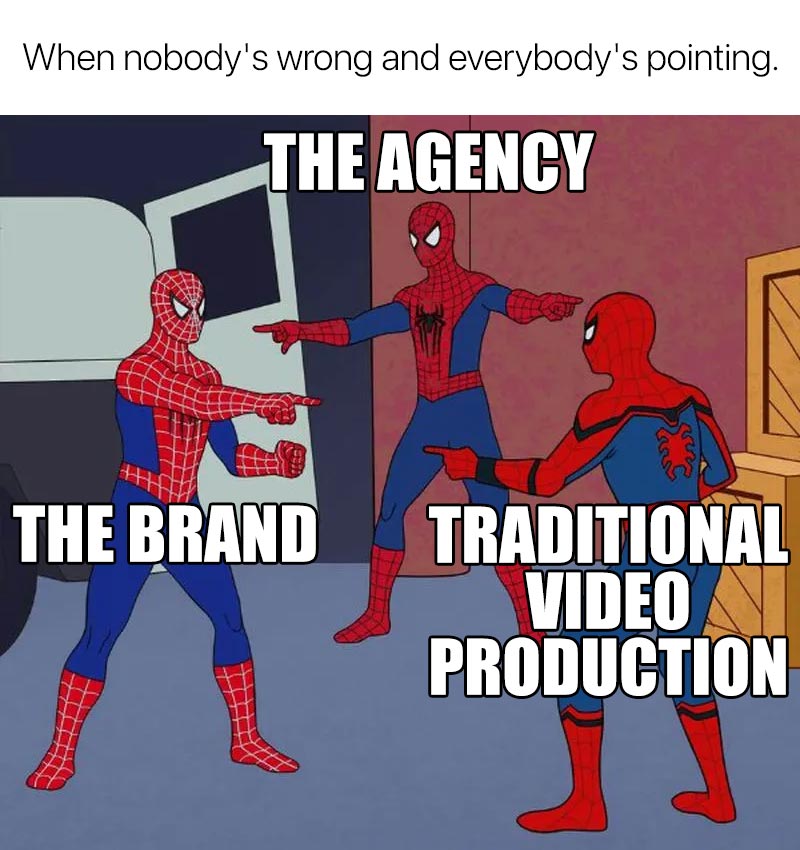
Nobody in the room is having the same conversation
Picture a brand that sets out to make a video. Three groups end up in the room, and every one of them is having a different conversation.
The Traditional Agency is talking about how cool the idea is. That's literally their job. The creative director is not thinking about MER (marketing efficiency ratio). They're thinking, what's a great idea to sell this product. So you get a speakeasy concept that means building a fake snowy alley in Brooklyn in the middle of July. Fake snow. Made it look like night in the middle of the day. Gorgeous. But nobody stopped to ask if it needed to be that.
The Modern Brand is talking about money and performance. They need each video to cost less, because they need to make more content more often. But they don't know where to save, or how to scale video to their strategy in a way that still feels on brand. Or they go the other way and throw money at one big idea, the one idea to rule them all. When the video doesn't "work," it's a failure. But damn, it was pretty.
And Traditional Video Production is still talking about the one video, because that's the era the system was built in. One shoot a year for the brand, the whole crew in the room, gaffer, grip, best boy, three hundred grand, and you made that one video perfect because it had to carry the whole year. Producers still reach for that: make the one project amazing, which usually means expensive. It made total sense when you couldn't measure anything, you got one shot, and there was one place to run it. It makes zero sense now:
- The tech that justified all that crew has changed.
- Cameras practically see in the dark now.
- Lights are smaller and brighter and cost a fraction of what they used to.
- AI audio plugins are absolute magic.
- The list goes on.
So you don't need the whole machine to make something look great. And the brand doesn't need one big video anymore. They need ads on ads on ads: test, iterate, pivot.
Three conversations. Not one of them is about the only thing that matters, which is: what does this video actually need to do, and how are you going to know if it did.
Measurement changed what a video is even for
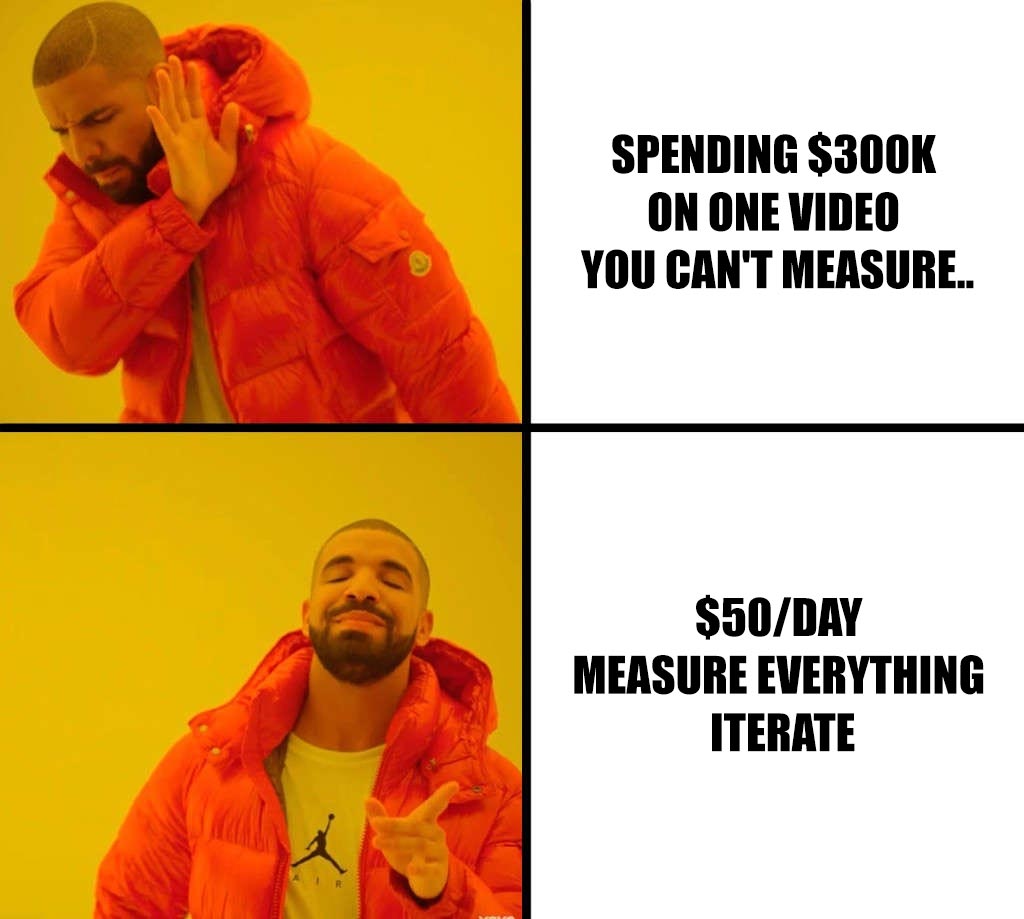
Video marketing was built for a world where you couldn't measure anything.
That world is gone. You can put a spot on connected TV for fifty dollars a day. That same shoot can run on Meta, on Google, on your website, as a static ad, as an organic post, as an email newsletter. And you can see what's working almost right away.
Which flips the whole question. It used to be, "what's the one video I want to make." Now it's, what's the system this brand needs after the shoot. Because here's the honest part: if you're the brand, you cannot actually tell me in pre-production which video will be most effective. You don't know yet. You need to shoot two or three concepts so you can find out which one lands, and then go hard on the winner, swap the hook, change the intro, iterate.
You can't do any of that if you dumped the whole budget into one perfect video. The whole model is systemically flawed, built for an era that no longer exists.
Stop buying the pizza
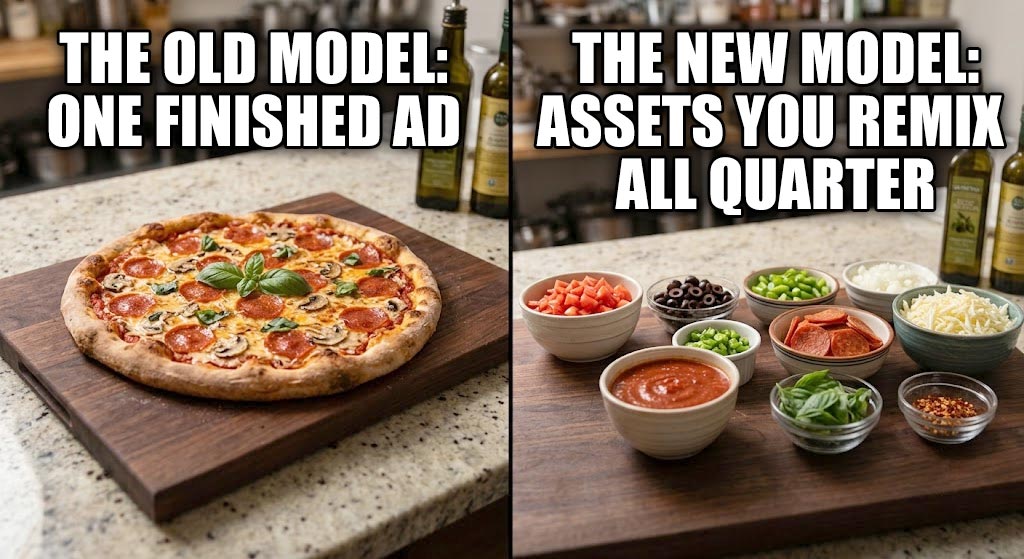
The old model hands you a finished thing. Here's your perfect 30-second ad. Here's your pizza.
The trouble with a pizza is you can't make anything else out of it. It's done. That's dinner.
What a brand actually needs now is pre-cut ingredients. We're already on set. We've got the talent, the location, the crew, all of it. So instead of shooting the one asset you ordered, we shoot for the whole process you're about to walk into. A few different scenarios in one day, bucketed so you can build a bunch of things out of them. All the footage clipped, colored, organized, handed to you. We're pre-chopping the ingredients into little bowls instead of handing you one finished dish. Then the real conversation starts: okay, what are we making over the next few months?
It doesn't cost more. We're already there. You just get more out of the same day. Right-size the project to the objective, the repeatable resources, and the iteration process.
Here's what that looks like with a real brand
Take PARKIT, an outdoor brand we work with. Chairs, coolers, that world. Call it a ten-million-dollar company, growing like wildfire. Too big for the one-guy-with-a-camera thing, but not trying to hire a bloated agency. So they kept bringing in solo videographers who'd show up, shoot some nice-looking stuff, and leave. But nobody was giving those shooters any real direction. Every shoot was one asset. No system.
So we sat down and did the thing we always do: asked a lot of questions. Your brand's about bringing people together around the fire, right? Great. Then why is every single video a person sitting alone in the chair? If the chair brings people together, show it bringing people together. Jess put it best: your chair should never be alone. When there's a scene, there's got to be people in it.
And that turned into Visual Rules:
- When people are in the shot, stack bodies, put a shoulder in the foreground.
- The cooler's black, so lift the shadows enough that you can actually see the welded rubber detail, because that detail is what makes it read as high quality, and if the image is too dark you lose the whole thing you're selling.
- Every setup gets a wide, a medium, a close. Film the whole interaction so you can build scenes, and match them to future scenes you shoot.
- These six features get shot every single time.
The list goes on. We wrote all of it down and handed it back as a document: here's how to shoot your chair. And now they give that same document to every video team or creator they bring on. On top of that we built them a content system, one shoot day bucketed into scenarios, all the footage organized, so they can turn out ads across the whole year instead of commissioning them one sad video at a time.
They'd originally come to us for a founder video. And we said, cool, love it, but we've got you for the day. An hour of interviewing the founder leaves most of a shoot day just sitting there. What else can we make while we're here? That turned into way more deliverables for the same price, because we were already there.
And here's the thing: every brand we work with ends up in this exact same conversation, no matter their size. Let's make the most of those shoot days.
The takeaway
You're not buying a video anymore. You're buying a content system, and the ability to find out what actually works before you've spent the whole budget on something that didn't.
So before anybody picks up a camera, ask the questions all three conversations skip right past. What is this for? Who is it for? How will you know if it worked? And, while we're at it, what else can we make while we're here?
That's the whole job. Everything good comes after those questions. Nothing good comes before them.
You May Also Like
View All Posts ›


LET'S GET STARTED.
We'll show you exactly how to turn your upcoming events into content gold mines. No pitch deck, just strategy.
Book a Free Strategy Session